Castellani
Castellani — Micromosaic Brooch, c. 1870
Castellani — Micromosaic Brooch, c. 1870
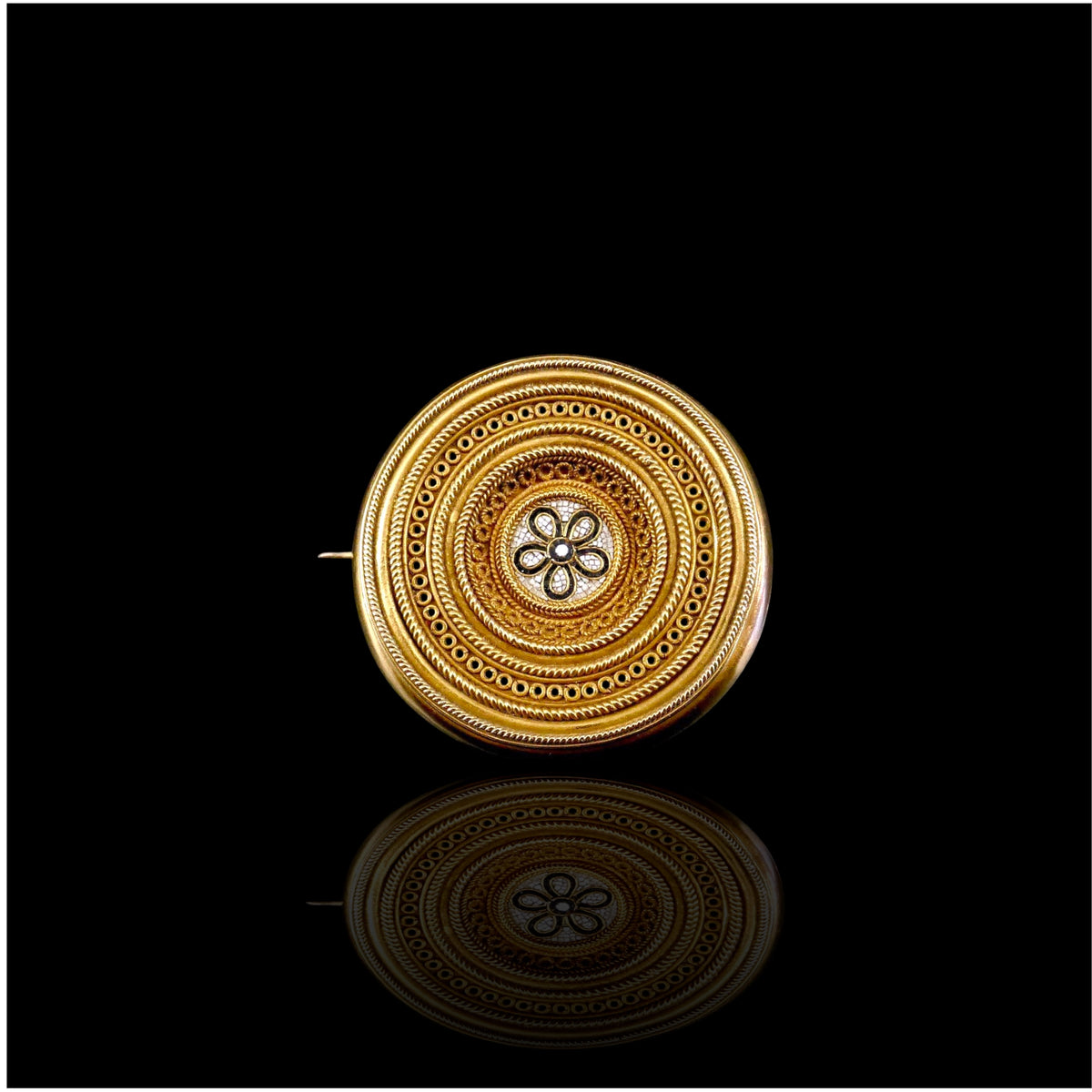
A refined example of the archaeological revival jewellery for which Castellani of Rome became internationally celebrated during the nineteenth century.
This circular brooch is crafted in 14-carat yellow gold and centred with a finely executed micromosaic flower, composed of minute coloured glass tesserae forming five petals.
The micromosaic is framed by a characteristic border of gold fettuccine, surrounded by concentric bands of twisted and beaded gold wire. The outer edge is finished with a delicate openwork border of repeating circular motifs, creating the rich texture and intricate surface associated with Castellani’s Neo-Etruscan work.
The reverse bears the Castellani maker’s mark of two interlaced “C”s within a cartouche.
Floral subjects appear in the Castellani workshops’ records from at least September 1860, while related gold and micromosaic jewels are preserved in major museum collections including The Metropolitan Museum of Art, New York, and the British Museum, London.
A particularly charming and wearable example of Roman archaeological revival jewellery, combining the virtuosity of Italian micromosaic with Castellani’s distinctive goldsmithing.
Maker: Castellani, Rome
Date: c.1870
Material: 14-carat yellow gold and glass micromosaic
Diameter: approximately 2.7 cm
Gross weight: 6.8 g
Mark: Two interlaced “C”s within a cartouche
Condition
Good overall condition. A small localised dent to the gold mount and light surface wear consistent with age. The micromosaic is well preserved, with no apparent losses.
Related literature
Geoffrey C. Munn, Castellani and Giuliano: Revivalist Jewellers of the Nineteenth Century, 1984.
Susan Weber Soros and Stefanie Walker (eds.), Castellani and Italian Archaeological Jewelry, 2004.
Share